


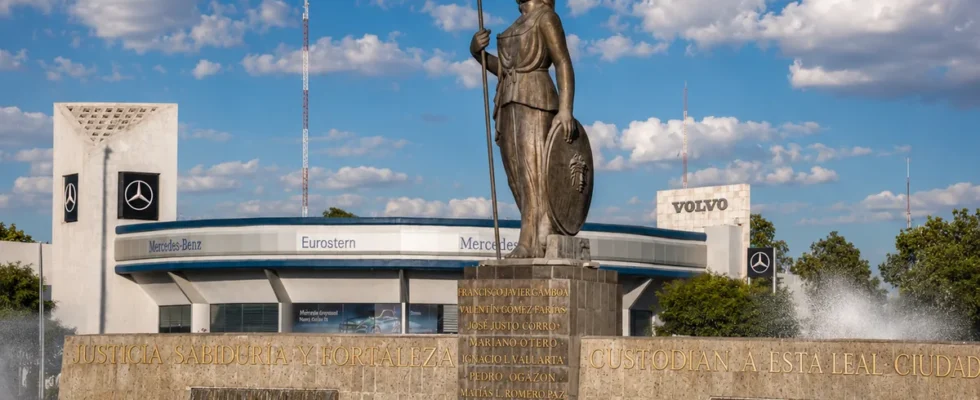
For almost 70 years, seeing La Minerva in Guadalajara up close meant risking your life crossing five lanes of traffic. That is over. Since January 13, 2026, the roundabout has had a full pedestrian walkway around the fountain, with room for about 500 people, and you can finally walk at the goddess’s feet, sit facing her and see every detail of the pedestal. If you are planning a visit, here is all the practical information first (how to get there, how much time to allow, where to take the best photo and what to do nearby) and, further down, the full history and the meaning of each symbol of this Guadalajara icon.
📌 Your visit in 20 seconds: Free admission · Suggested time: 15-30 min · Open-air and accessible 24 hours · Best time for photos: sunset · Wheelchair and stroller accessible · Free Red Jalisco wifi · MiBici bike-share station right next to it · Walking distance from the Arcos de Guadalajara and Av. Chapultepec.
How to visit La Minerva now that it is pedestrian-friendly
“Visiting” La Minerva used to mean taking a photo from the sidewalk, from a distance. Now you can walk the entire perimeter of the fountain, sit on the low walls that double as benches and get close enough to read the inscriptions on the pedestal and see details of the statue that once required a telephoto lens. Fifteen to 30 minutes is plenty to walk all the way around, take photos and read the engravings; if you combine it with a stroll along Chapultepec, it easily becomes a whole afternoon.
Admission is free and the roundabout is open-air, so you can see it at any hour. For photos, sunset is unbeatable: the sun hits the statue from the side and, as the light fades, the fountain’s illuminated jets switch on. The classic shot is from the walkway on the Arcos side, with the goddess facing you and her spear outlined against the sky.
📷 Tips for your visit: Cross only at the marked crosswalks on the corners of Vallarta, López Mateos, Golfo de Cortés and Agustín Yáñez; they have visual and audible signals, so wait for yours. · The best light for photos is at sunset, once the jets are on. · If you go on a weekend when Chivas or the Mexican national team is playing, avoid the area for several hours before and after: the victory caravans can close the lanes around the roundabout. · The walkway is 100% accessible (ramps around the entire perimeter), a good stop in a wheelchair or with a stroller.
Is it safe? Yes. It is one of the busiest and most closely monitored areas in Guadalajara, well lit and with a steady flow of people at almost any hour. During the day it is a relaxed stop for any visitor; at night, as in any city, stay within the lit perimeter and do not cross the lanes outside the crosswalks.
How to get to La Minerva in Guadalajara
La Minerva sits at the intersection of Av. Adolfo López Mateos, Av. Ignacio L. Vallarta, Diagonal Golfo de Cortés and Circunvalación Agustín Yáñez, right on the border between the Chapultepec and Providencia neighborhoods, next to the Arcos de Guadalajara. It is a landmark that every local, and every rideshare driver, recognizes instantly.
🚲 By MiBici: a new station was installed right next to the monument during the renovation. Check the station map on the official MiBici website.
🚌 By public transportation: buses no longer enter the roundabout; routes go around it via the Fernando de Celada loop. Get off at any nearby stop on Vallarta or López Mateos.
🚗 By car: all five traffic lanes remain; there are public and private parking lots on Av. Vallarta, in the Chapultepec area.
🚕 By rideshare app: the simplest option if you are coming from downtown or Zapopan; ask to be dropped off on the outer loop, on the Arcos side.
If you will be getting around the city over several days, read our guide to public transportation in Guadalajara to understand routes, MiBici and the bus system before you head out.
Things to see and do near La Minerva
The roundabout is in one of the most walkable parts of Guadalajara, so it is rarely a stand-alone visit. A good walking route starts at La Minerva, continues to the Arcos and heads down Chapultepec, and you can extend it to Providencia if the plan includes a good meal.
- Arcos de Guadalajara: a few steps from the roundabout, crossing toward Vallarta. It is another of the city’s most photographed landmarks and the natural companion to your La Minerva photo; both monuments fit into the same walk.
- Avenida Chapultepec: the liveliest pedestrian median in the city, lined with cafés, bars, patios and food trucks. Ideal for sitting down after your visit. On Fridays and weekends there is often a cultural street market and activity into the night.
- Colonia Providencia: a leafy residential neighborhood a few minutes away, with some of the best restaurants in Guadalajara, from upscale seafood to chef-driven cuisine.
- Vallarta corridor toward Zapopan: a wide, walkable avenue that connects with shopping centers, cafés and stores if you want to extend your walk.
To plan your meals around the roundabout, these guides will find you a table for any time of day:
📖 Eat near La Minerva: The best breakfast spots in Guadalajara — to start the day | The best seafood restaurants — Providencia’s specialty | Guadalajara shopping malls — if you want shade and air conditioning
What La Minerva means and why Guadalajara chose this goddess
Minerva is the Roman version of Athena: goddess of wisdom, strategy, justice, the arts, medicine and commerce. Governor Agustín Yáñez, a novelist with a passion for the classical Greco-Roman world, chose her because she embodied what he wanted 1950s Guadalajara to project: a city leaving behind its big-town past to become a cultured, orderly and prosperous regional capital. The idea was so literal that at the time there was talk of turning the city into the “Athens of Mexico.”
The statue stands upright, with her torso slightly turned to suggest movement, wrapped in a tunic cinched at the waist and with the aegis covering her chest. She wears a war helmet with a Roman crest, holds a spear resting on the ground and, in her left hand, carries a round shield with the gorgoneion (the face of Medusa) engraved in the center. At her feet lies a python.
The two low walls flanking the pedestal are engraved with the two phrases that sum up the monument’s purpose. On the front:
“JUSTICIA, SABIDURÍA Y FORTALEZA CUSTODIAN A ESTA LEAL CIUDAD” (Justice, wisdom and strength guard this loyal city)
And on the back: “A LA GLORIA DE GUADALAJARA” (To the glory of Guadalajara).
La Minerva history: what it is made of and who commissioned it
📌 Monument quick facts: Unveiled on September 15, 1957 · Sculptor: Joaquín Arias · Architect of the ensemble: Julio de la Peña · Bronze statue 8 meters (26 ft) tall (about 4.5 tons) · Circular fountain 74 meters (243 ft) in diameter (86 m / 282 ft including the lawn ring) · Intersection of Av. López Mateos, Av. Vallarta, Diagonal Golfo de Cortés and Circunvalación Agustín Yáñez · Second-largest fountain in Guadalajara, after the one in Parque Alcalde.
Yáñez commissioned the project in the 1950s with a specific goal: Guadalajara was growing westward and needed a gateway worthy of a “cultured city.” The intersection where the roundabout stands today was, at the time, literally the entrance to the city. Architect Julio de la Peña designed the ensemble, and the central sculpture was commissioned from Joaquín Arias. The statue is bronze, measures 8 meters from head to toe and arrived in three parts from the sculptor’s workshop in San Luis Potosí; as soon as it was assembled and unveiled on September 15, 1957, it became an icon of the Jalisco capital.
The debut was not free of controversy. As soon as it was installed, the criticism began: the face was not feminine enough, the proportions were miscalculated. Sculptor Pedro Medina Guzmán, who had worked on the piece, was asked to modify it to make it more stylized. He refused. La Minerva stayed exactly as it had been conceived, and over time the same proportions that caused the scandal became part of its identity.
A story about the goddess’s face has circulated for decades: that her mestizo features (Yáñez explicitly wanted a Mexican Minerva, not a copy of Greco-Roman marble) were inspired by Olivia Ramírez Ramos, a writer born in Sayula in 1914 and the wife of the governor at the time. The best-documented version says the sculptor used photographs of her as a reference to achieve that blend. There is no full agreement on whether she was the model or just one of several references, and at the time the rumor caused a stir in a conservative city. What is certain is that Yáñez’s instruction was clear: he wanted a Minerva with Indigenous and mestizo features, not the classical European goddess.
The 18 names engraved on the pedestal
This is one of the least-known facts about La Minerva: the pedestal is engraved with the names of 18 people from Guadalajara whom Agustín Yáñez considered fundamental to the city’s development. Most people have walked past the monument hundreds of times without noticing the list. These are the documented names, with the profession that earned each a place there:
- Francisco Javier Gamboa — jurist
- Valentín Gómez Farías — patriarch of the Reform movement
- José Justo Corro — politician
- Mariano Otero — lawyer and politician
- Ignacio L. Vallarta — author of the juicio de amparo (Mexico’s constitutional protection lawsuit)
- Pedro Ogazón — reformist politician
- Matías de la Mota Padilla — historian
- Luis Pérez Verdía — jurist and historian
- Fernando Calderón — lawyer, poet and politician
- José María Vigil — politician and writer
- José López Portillo y Rojas — lawyer and writer
- Enrique González Martínez — poet
- Manuel López Cotilla — educator
- Salvador García Diego — physician
- Pablo Gutiérrez — physician
- Jacobo Gálvez — architect and painter
- Manuel Gómez Ibarra — architect
In the lawn ring around the fountain (which extends the diameter to 86 meters) there is usually seasonal landscaping: flowers, phrases or commemorative dates spelled out in plants and, for years now, agave, the plant that identifies Jalisco around the world.
The fountain has undergone at least two major renovations. In 2018 the structure was restored after decades of exposure to the elements and traffic vibrations caused serious damage; during that work, the statue was fully wrapped and covered. The second, far more ambitious one is the project that reopened in January 2026, explained below.
📖 Other Guadalajara landmarks: Guadalajara Cathedral — the religious heart of downtown | Teatro Degollado — the other neoclassical icon | Rotonda de los Jaliscienses Ilustres — a tribute to notable people from Jalisco
The center of Guadalajara’s celebrations (and protests)
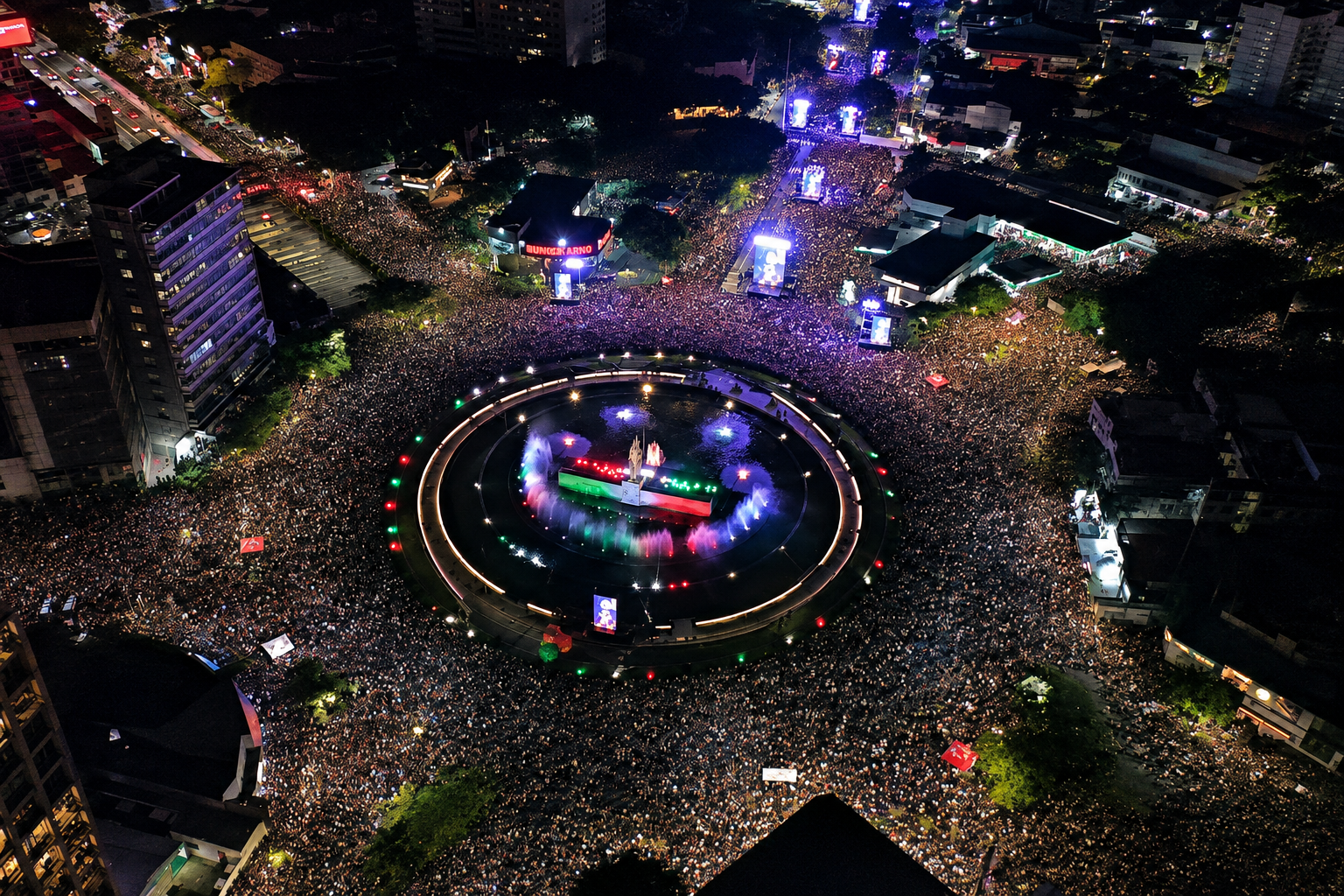
No one planned for La Minerva to become the city’s living room. It happened almost by accident. During the 1986 World Cup in Mexico, Brazil won a match and its coach gave the players the afternoon off; the celebration ended up right there, where López Mateos, Vallarta, Golfo de Cortés and Circunvalación Agustín Yáñez meet. From that day on, celebrations and demonstrations adopted the roundabout as their favorite stage, and four decades later the custom is still alive.
Chivas and the Mexican national team
No team has made La Minerva its own the way Club Deportivo Guadalajara has. Every title, every semifinal berth, every big win for Chivas ends with caravans of fans circling the roundabout, red-and-white flags draped on the statue and honking until the early hours. Fans of the national team repeat the same ritual when El Tri wins important matches, especially at World Cups.
Concerts and public events
The roundabout also works as an open-air venue. In June 2026, for example, Alejandro Fernández gave a free concert right at La Minerva, one of the largest music events the monument has hosted in recent years. It is not an isolated case: exhibitions, concerts and special events use the roundabout as a natural stage, since it is instantly recognizable and sits at a central point in the city.
Demonstrations and social causes
La Minerva is not only about celebrating. It is also where Guadalajara goes to make demands. Feminist groups have dyed the fountain’s water red to protest femicides in Jalisco, an image repeated several times in recent years. Unions, citizen groups and social movements use the roundabout as the starting point for marches because of its visibility and symbolism: protesting in front of the “guardian of the city” carries a weight no other corner has. Since 2014, La Minerva has also been the official starting point of Guadalajara Pride, the city’s LGBT+ pride march.
The 2025-2026 renovation: from traffic interchange to public space
The project that made the roundabout pedestrian-friendly began in September 2025 and reopened on the night of Tuesday, January 13, 2026, led by Governor Pablo Lemus and Guadalajara Mayor Verónica Delgadillo as part of the city’s modernization ahead of the 2026 World Cup, along with the renovation of Plaza Guadalajara in the historic center. The timing was deliberate: it was designed for the wave of fans, local and visiting, who would use the roundabout as a meeting point during the tournament, with Guadalajara as one of the host cities.
🚧 The renovation by the numbers: Start: September 2025 · Reopening: January 13, 2026 · Duration: more than 5 months · Final investment: MXN $70 million (original budget: MXN $46 million) · More than 24,000 m² (258,000 sq ft) of renovated space · Walkway capacity: approx. 500 people · All 5 traffic lanes were kept intact.
Specifically, here is what changed:
- A pedestrian walkway around the entire roundabout, lined with greenery and low walls that serve as benches.
- The inner radius of the roundabout was enlarged, taking space from the asphalt without removing any traffic lanes.
- Safe crosswalks at the corners of Agustín Yáñez, Vallarta, Golfo de Cortés and López Mateos, with visual and audible signals to ensure accessibility.
- Universal-access ramps and wider sidewalks around the entire perimeter.
- New lighting, trees and bollards, plus stamped concrete on the walkways.
- Renewed jets and fountains, with fully rehabilitated plumbing.
- A MiBici station installed next to the monument.
- Free wifi through Red Jalisco.
- Public buses no longer enter the roundabout; they now use the Fernando de Celada loop.
- Better pedestrian connections with the Arcos de Guadalajara and nearby parks.
On reopening day, Mayor Verónica Delgadillo summed up the project’s intent: she described it as taking La Minerva to a completely different level, as if the goddess were stepping off her pedestal to come closer to the people of Guadalajara, so that it stops being a monument to contemplate and becomes a space the public can actually use.
📖 2026 World Cup in Guadalajara: Where to watch the World Cup in Guadalajara — free and paid venues | 2026 World Cup concert guide — free and paid shows | Where to stay during the World Cup
La Minerva Guadalajara FAQ
Can you walk around La Minerva?
Yes, since the renovation that reopened on January 13, 2026. Before, you had to see it from the outer sidewalk; now there is a full pedestrian walkway around the fountain, with room for about 500 people, accessible and with safe crosswalks at all four corners of the roundabout.
How much does it cost to visit La Minerva?
Nothing. It is an open-air public space with free admission, open 24 hours. Just use the crosswalks to reach the walkway.
How much time do you need to visit?
Fifteen to 30 minutes is enough to walk all the way around, read the inscriptions on the pedestal and take photos. If you combine it with the Arcos de Guadalajara and a walk along Av. Chapultepec, it easily becomes a whole afternoon.
What is La Minerva made of and how tall is it?
It is a bronze sculpture 8 meters (26 ft) tall (about 4.5 tons), the work of Joaquín Arias. The circular fountain around it is 74 meters (243 ft) in diameter, or 86 meters (282 ft) including the outer lawn ring.
Who built La Minerva and when?
It was unveiled on September 15, 1957, commissioned by Governor Agustín Yáñez. Architect Julio de la Peña designed the ensemble and sculptor Joaquín Arias made the statue. The piece arrived from San Luis Potosí in 1956 and was unveiled the following year, which is why its anniversary is celebrated every September 15.
Why is it called La Minerva?
After the statue that crowns the fountain, which represents Minerva, the Roman goddess of wisdom, justice and the arts. Agustín Yáñez chose her as a symbol of the cultured city Guadalajara aspired to be in the 1950s.
Is it safe to visit La Minerva?
Yes. It is one of the busiest, best-lit and most closely monitored areas in Guadalajara, with a steady flow of people. During the day it is a relaxed stop; at night, as in any city, stay within the lit perimeter and cross only at the marked crosswalks.
Why do Chivas fans celebrate at La Minerva?
The custom dates back to the 1986 World Cup in Mexico, when Brazil’s team celebrated a win there. Since then, local fans, starting with those of Chivas, have adopted the roundabout as their favorite place to celebrate sports victories and shared achievements.
Did the renovation remove lanes from the roundabout?
No. Authorities kept all five traffic lanes, since the roundabout is still a key traffic interchange. The pedestrian space was gained by enlarging the inner radius, not by reducing lanes.
📖 Keep exploring Guadalajara: 10 beautiful places you should see | The best museums in Guadalajara | Essential Guadalajara travel information | Public transportation