


Jalisco has something few Mexican states can match: twelve Pueblos Mágicos (“Magic Towns,” an official federal designation for towns of special cultural or natural value) spread across mountains, lakes and agave valleys. From lively, festive Tequila to quiet, little-known Mascota, each has an identity that goes well beyond painted façades and wooden porticos. And although it is not a Pueblo Mágico, if you like crafts, do not miss the Tonalá tianguis (open-air street market) on the edge of Guadalajara.
📖 Related article: Things to do in Tequila, Jalisco: a guide to the Pueblo Mágico, with distilleries, the José Cuervo train and more
If you live in or are visiting Guadalajara, the nearest of these towns is less than an hour away and the farthest just over three. They are ideal for short weekends, long-weekend getaways or day trips when you need a break from the city.
This guide has everything you need to choose and visit Jalisco’s twelve Pueblos Mágicos: what to do in each, how to get there from Guadalajara, where to eat, where to stay, how much it costs and when to go. We will also tell you honestly which ones are worth the longer drive and which work better as a quick stop.
📋 Overview: Jalisco has 12 Pueblos Mágicos, tied with the State of Mexico and Puebla for the most in the country. The designation is granted by Mexico’s federal Ministry of Tourism (Secretaría de Turismo) to towns with significant cultural, historical or natural value. Mexico has 177 Pueblos Mágicos in total.
📖 Related article: Guide to the Tonalá Tianguis: market days and hours, what to buy, how to bargain and how to get there.
What Is a Pueblo Mágico?
The Pueblos Mágicos program was launched in 2001 by Mexico’s federal Ministry of Tourism. Its goal is to recognize and preserve towns with exceptional cultural, historical, natural or culinary value: in short, places with something truly unique to offer visitors.
To earn the designation, a municipality must meet specific criteria: preserve its tangible heritage (architecture, monuments, landscapes) and intangible heritage (traditions, food, crafts), have basic tourism infrastructure, and have a community actively involved in preserving its identity. The designation is not permanent: it can be withdrawn if a town stops meeting the standards.
In practice, visiting a Pueblo Mágico usually means cobblestone streets, well-kept plazas, authentic regional food and a human scale that contrasts with the pace of the city. What changes from one to the next is the character: each town has its own.
Jalisco’s 12 Pueblos Mágicos: An Overview
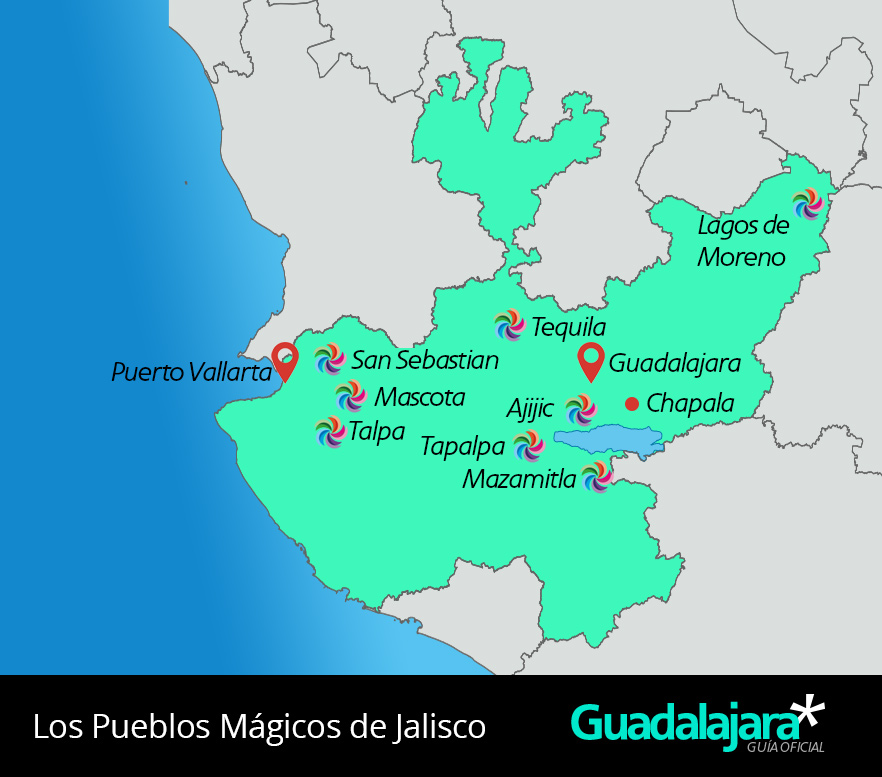
Before we look at each town in detail, here is a quick table to help you get your bearings:
| Pueblo Mágico | Distance from Guadalajara | Best for | Year designated |
|---|---|---|---|
| Tlaquepaque | 10 km (6 mi) · 20 min | Crafts, food, full day | 2002 |
| Ajijic | 55 km (34 mi) · 1 hour | Art, lake, expat community, relaxing | 2020 |
| Cocula | 56 km (35 mi) · 1 hour | Mariachi, culture, half day | 2022 |
| Tequila | 65 km (40 mi) · 1.5 h | Distilleries, tours, full day | 2003 |
| Tapalpa | 130 km (81 mi) · 2.5 h | Adventure, forest, weekend | 2001 |
| Mazamitla | 135 km (84 mi) · 2.5 h | Nature, cabins, unplugging | 2011 |
| Sayula | 154 km (96 mi) · 2 h | History, food, crafts | 2023 |
| Lagos de Moreno | 187 km (116 mi) · 2 h | Architecture, history, colonial | 2002 |
| Temacapulín | 175 km (109 mi) · 2.5 h | Hot springs, rest, wellness | 2023 |
| Talpa de Allende | 203 km (126 mi) · 3.5 h | Pilgrimage, faith, nature | 2002 |
| Mascota | 206 km (128 mi) · 3.5 h | Ecotourism, authentic small towns, off the radar | 2015 |
| San Sebastián del Oeste | 254 km (158 mi) · 3.5 h | Mining history, mountains, adventure, remoteness | 2002 |
1. Ajijic: Art and a Lake 55 km from Guadalajara

Ajijic is the most international of Jalisco’s twelve Pueblos Mágicos. Its name comes from the Nahuatl “Axixic,” meaning place where the water splashes, and it fits: the town stretches between the mountains and the shores of Lake Chapala, Mexico’s largest natural lake.
What sets Ajijic apart from the rest of Jalisco’s Pueblos Mágicos is not only its natural beauty but its cultural mix. It is home to the largest community of American and Canadian expats in Mexico, with an estimated 10,000 to 15,000 foreign residents. That has created an unusual setting: cobblestone streets with colorful murals, contemporary art galleries next to neighborhood taco stands, and a range of spas and international restaurants you will find in few inland Mexican towns.
The malecón (lakeside promenade) is the backbone of life in Ajijic. From there the lake seems to go on forever, especially in the late afternoon when the sunset turns the water orange and pink. You can hire a boat ride to explore the shoreline, visit the docks of neighboring towns or simply sit on a bench and watch the horizon. The main plaza, a few blocks from the lake, has the flowers and trees that give the town its life, and the Iglesia de San Andrés Apóstol has one of the most photogenic façades on the lakeshore.
The craft market and painting studios are another draw. Several local and foreign artists exhibit and sell in galleries along the cobblestone streets. If you are interested in art, set aside at least a morning to walk the art corridor between Calle Morelos and Calle Ocampo.
Things to do in Ajijic: walk the malecón and the main plaza · tour the art galleries · take a boat ride on Lake Chapala · see the murals along the art corridor · book a spa treatment · browse the weekend craft market
Where to Eat in Ajijic
Teocintle: Mexican chef-driven cuisine. $$$
Ajijic Tango: Argentine cuisine, steaks. $$$$
CocinART: International cuisine. $$$
Trip’s Burgers: Handcrafted burgers. $$$
ℹ️ Practical info, Ajijic: Distance from Guadalajara: 55 km (34 miles) on a toll-free road · Time: approx. 1 hour · By bus: from Guadalajara’s Central Camionera Vieja (old bus terminal), Chapala Plus line · By car: Guadalajara–Chapala highway, accessed via Av. López Mateos Sur · Best time to go: year-round, mild weather between 18-24°C (64-75°F) · Daily budget: MXN $500–$1,200 including food and activities.
10 Beautiful Places in Guadalajara: unique spots with practical tips, hours and the essentials for planning your trip.
2. Cocula: The Birthplace of Mariachi, Just 56 km Away

Of Jalisco’s twelve Pueblos Mágicos, Cocula is one of the closest to Guadalajara, along with Tlaquepaque: just 56 kilometers (35 miles) on a toll-free road, under an hour by car. That makes it a perfect half-day trip, although it is well worth staying for lunch and exploring at a relaxed pace.
Its name comes from the Nahuatl “Cōcuilān,” meaning place of copper, a reference to the mining that shaped its early centuries. Today, though, Cocula is associated not with copper but with something that sounds much better: mariachi. Cocula is officially recognized as the Cradle of Mariachi, and the title is more than a tourism slogan. Historical research suggests that the string and brass ensemble that would later win over Mexico and the world was born in the area around this town. A monument in the plaza and music festivals throughout the year reinforce the claim.
Cocula’s historic center is smaller than that of Lagos de Moreno but just as valuable. The Parroquia de San Miguel Arcángel, also called San Francisco in some records, dominates the plaza with its Baroque façade and carved towers. The surrounding cobblestone streets come alive on weekends, when regional food stalls and local artisans fill the arcades.
The Museo del Mariachi, a few blocks from the plaza, is a must to understand how this music was born and evolved. The Casa de la Cultura (cultural center) runs folk dance workshops, which you can check on its website before your visit.
Things to do in Cocula: explore the historic center · visit the Museo del Mariachi · catch a concert or festival in the plaza · try Cocula-style birria and pozole · visit the Parroquia de San Miguel Arcángel · tour the Casa de la Cultura
Where to Eat in Cocula
Birrieria Pelé Campestre: Traditional food, beef birria. $$$
Mi Gusto Es: Mexican. $$$$
Las Brasas Grill: Grill. $$$
ℹ️ Practical info, Cocula: Distance from Guadalajara: 56 km (35 miles) · Time: approx. 1 hour · By car: Guadalajara–Barra de Navidad highway, then the turnoff to Cocula · By bus: from the Central Camionera Vieja, lines serving the Costa Sur · Best time to go: October–March (Fiestas Patrias and the Mariachi Festival) · Budget: MXN $300–$700 per day.
Traveling on business? Find the best way to get around with an executive transportation service in Guadalajara, with a modern, varied fleet and professional drivers. 🚗
3. Lagos de Moreno: The Only UNESCO Site Among Jalisco’s Pueblos Mágicos

Lagos de Moreno is the colonial jewel of Jalisco’s Pueblos Mágicos. “Lagos,” as locals call it, is the only one of the twelve towns recognized by UNESCO: in 2010 the organization declared its historic center and the old colonial bridge over the Lagos River, right in the heart of town, a World Heritage Site.
The reason is clear at first sight: Lagos de Moreno has one of the most complete and intact Baroque historic centers in the Bajío region. Its 18th-century mansions, pink stone churches and tree-lined plazas form an urban ensemble few towns in the country can match. The city reached its peak between the 17th and 19th centuries, when it was a leading commercial and cultural hub of Nueva Galicia (the colonial province that included Jalisco).
The highlight of the historic center is the Templo del Calvario, on the Cerro de la Calavera hill. Inspired by St. Peter’s Basilica in Rome, this Neoclassical building is the highest and most photographed point in Lagos. From its atrium there is a panoramic view of the town that makes the climb worthwhile. At the foot of the hill, on the main plaza, stands the Parroquia de Nuestra Señora de la Asunción, with its 18th-century Baroque façade and two 72-meter (236-foot) towers.
The Teatro José Rosas Moreno, built in 1867, is another must. In its day it was the most important theater in northern Jalisco; one look at its Neoclassical, Porfirian-era façade shows how much cultural weight Lagos carried in the 19th century. The Museo de Arte Sacro, with five galleries of colonial-era paintings and religious images, rounds out a tour of the city’s heritage.
Lagos de Moreno is 187 km (116 miles) from Guadalajara by highway, a drive of just over two hours. That is enough for a full weekend or a 24-hour getaway with an overnight stay.

Things to do in Lagos de Moreno: climb to the Templo del Calvario for the panoramic view · explore the historic center on foot · visit the Parroquia de la Asunción · walk across the colonial bridge · Teatro José Rosas Moreno · Museo de Arte Sacro · try the food of the Altos region: carnitas, birria and artisanal cheeses
Where to Eat in Lagos de Moreno
La Rinconada: Mexican cuisine. $$$
Terrescalli: International cuisine. $$$
Porco Smokehouse: Barbecue. $$
ℹ️ Practical info, Lagos de Moreno: Distance from Guadalajara: 187 km (116 miles) by toll highway (204 km / 127 miles on the free road) · Time: approx. 2 hours · By bus: from Guadalajara’s Central Vieja and Central Nueva terminals · By car: Guadalajara–Aguascalientes highway · Best time to go: year-round; major festivals in January (Feria Regional) and April · Budget: MXN $700–$1,500 per day.
Find out where to watch the World Cup in Guadalajara: the Fan Fest, fan zones, sports bars and World Cup experiences not to miss. 🌎🏆
4. Mascota: The Emerald of the Sierra

If you are looking for a Pueblo Mágico in Jalisco that does not feel like a tourist stage set, Mascota is your place. Some 206 kilometers (128 miles) from Guadalajara, deep in the Sierra Madre Occidental, Mascota is one of the state’s best-kept secrets. It earned its nickname, “The Emerald of the Sierra,” without trying: there are no brightly painted façades for Instagram. What it has instead is a rustic, authentic beauty that reveals itself as you get to know the town.
Mascota’s main plaza has a Neo-Mudéjar (Moorish Revival) bandstand that fits no category, which is exactly what makes it interesting. Beside it, the 18th-century Parroquia de Nuestra Señora de los Dolores has a modest Baroque façade that has aged with dignity. But Mascota’s most photographed sight is not the parish church: it is the Templo Inconcluso de la Preciosa Sangre (Unfinished Church of the Precious Blood), whose construction was halted by the Revolution and the Cristero War and never resumed. Its stone arches and roofless walls now frame gardens and serve as a stage for cultural events and theater performances.
The Museo Arqueológico de Mascota, a block from the plaza, is one of the least known but most interesting museums in the state: its four galleries display ceramic, stone and bone pieces recovered from a pre-Hispanic burial ground more than a thousand years old. The upper floor of the Mercado Regional offers the best selection of regional food at small-town prices: enchiladas, tamales, pozole and atole (a warm corn-based drink).
For nature lovers, the area around Mascota is a paradise. Laguna de Juanacatlán, a few kilometers from town, is a mirror-like lake surrounded by forest, ideal for picnics and photography. The Grutas del Espinazo del Diablo caves offer an underground excursion among ancient rock formations. And the Volcán El Molcajete, an extinct volcanic cone, is one of the most recommended climbs for experienced hikers.

Things to do in Mascota: explore the historic center and photograph the Templo Inconcluso · Museo Arqueológico · Laguna de Juanacatlán · Grutas del Espinazo del Diablo · climb the Volcán El Molcajete · eat at the Mercado Regional
Where to Eat in Mascota
Tapanco: Italian cuisine. $$
Café Nápoles: International. $$
Discover the traditional dishes of Jalisco: birria, tortas ahogadas, pozole and more, the authentic flavors that define the state’s cooking. 🌮🍖🍽️
ℹ️ Practical info, Mascota: Distance from Guadalajara: 206 km (128 miles) on the free road · Time: approx. 3.5 hours · By bus: from Guadalajara’s Central Vieja, Auto Transportes Mascota line · By car: free road from Guadalajara to Mascota via Ameca · Average annual temperature: 21°C (70°F) · Best time to go: November–April (dry season) · Budget: MXN $600–$1,200 per day.
Explore the best tacos in Guadalajara: distinctive flavors, tradition and authenticity in every bite. Find out where to eat the best ones. 🌮
5. Mazamitla: The “Mexican Switzerland”

Mazamitla is probably the most popular of Jalisco’s twelve Pueblos Mágicos, and for very concrete reasons: it is just 135 kilometers (84 miles) from Guadalajara, has some of the best tourism infrastructure in the state and offers the kind of getaway everyone looks for when they need to unplug: pine-scented air, a fireplace in the cabin and a pace of life measured in cups of coffee.
The nickname “The Mexican Switzerland” is not just marketing. Mazamitla’s cobblestone streets, white façades with wooden balconies, gabled clay-tile roofs and the cool, damp climate of the Sierra del Tigre create an alpine atmosphere that surprises first-time visitors. The town sits in the Sierra Madre Occidental at about 1,700 meters (5,600 feet) above sea level, which means temperatures between 15 and 22°C (59 and 72°F) for most of the year.
The Parroquia de San Cristóbal, at the heart of the main plaza, is Mazamitla’s most reproduced image. Its white façade mixes styles, with a clear Chinese influence in the tops of the towers, and dates from the mid-20th century, although the patina left by the mountain climate makes it look much older. The tree-filled plaza is the town’s weekend gathering place.
Beyond town, the Sierra del Tigre offers waterfalls, rivers, reservoirs and high ground with superb views. Parque Natural La Zanja organizes hiking routes for every level. You can also book ATV rides, zip lines, rappelling, paintball and, for the bolder, paragliding flights over the whole sierra.
Lodging is another strong point: Mazamitla has hotels in every category, glamping, apartments and cabins, from the most rustic to luxury options with a hot tub and private fireplace, all set in wooded areas.

Things to do in Mazamitla: walk around downtown and visit the plaza · Parque Natural La Zanja (hiking) · Cascada El Salto waterfall · ATV rides and zip lines · rappelling · paragliding · visit the plant nurseries and craft workshops · try guava atole and corn gorditas at the market
ℹ️ Practical info, Mazamitla: Distance from Guadalajara: 135 km (84 miles) on the free road (no tolls) · Time: approx. 2.5 hours · By bus: from Guadalajara’s Central Nueva terminal · By car: via Ciudad Guzmán or via Sayula · Elevation: 1,700 m (5,600 ft) · Temperature: 15–22°C (59–72°F) year-round · Best time to go: October–May (dry season; August is very foggy) · Budget: MXN $800–$2,000 per day (more if you stay in a cabin).
Mestizo: Mexican/international cuisine. $$$
Posada Mazamitla: Mexican, ranch-style cooking. $
Asado de Trivento: Mexican/international. $$$
Where to Eat in Mazamitla
Visit the impressive Guadalajara Cathedral, a historic landmark with grand architecture ⛪ and remarkable details. A must in the heart of the city. 🏙️
6. San Sebastián del Oeste: A Mountain Town Off the Beaten Path

San Sebastián del Oeste is the most intriguing of Jalisco’s Pueblos Mágicos. Founded in 1605 as Real San Sebastián, this old mining town had more than 20,000 residents and some fifty working mines at its peak in the 19th century. Today only about 5,000 people live here, but traces of that boom are everywhere: stone mansions, former haciendas and a plaza where time seems to have stopped.
What makes San Sebastián special is exactly what makes it hard to reach: it is 254 kilometers (158 miles) from Guadalajara, deep in the Sierra Madre Occidental, and until a few years ago getting there meant a long trek on dirt roads. New paved roads have made the trip easier from Guadalajara and especially from Puerto Vallarta, which is only 80 kilometers (50 miles) away in a straight line, although the route is a mountain road.
A walking tour of San Sebastián is short, since the town fits in a few blocks, but rewarding. Narrow streets lined with stone houses and wooden balconies feel like a movie set. The main plaza, with its well-kept garden and 18th-century church, is the center of town. The Mirador del Cerro de la Bufa lookout is a stop you should not skip: on clear days you can see the Bahía de Banderas and the Pacific coast, a view you do not expect at this point in the mountains.
For hikers, the Cascada La Ermita (also known as Cascada La Estancia de Landeros) is the most popular outing: a 90-minute walk through pine forest that ends at a waterfall with crystal-clear water. The trail to the Capilla de Nuestra Señora del Rosario in Real el Alto is another highly recommended route.

Things to do in San Sebastián del Oeste: explore the historic center on foot · visit the former haciendas · climb to the Mirador del Cerro de la Bufa · hike to the Cascada La Ermita · go horseback riding · visit old mines
Where to Eat in San Sebastián del Oeste
Jardín Nebulosa: Mexican cuisine. $$$
Villa Nogal: French/fusion cuisine. $$$
Montebello Restaurante Italiano: Italian cuisine. $$
El Galletero Mágico: Artisan bakery. $$
El Comedor de Lupita: Mexican cuisine. $$
ℹ️ Practical info, San Sebastián del Oeste: Distance from Guadalajara: 254 km (158 miles) · Time: approx. 3.5 hours · From Puerto Vallarta: approx. 80 km (50 miles), about 2 hours on a mountain road · By bus: Guadalajara’s Central Vieja → Mascota, then a connection to San Sebastián (Auto Transportes Mascota line) · Best time to go: November–May · Budget: MXN $700–$1,500 per day.
Explore the Tequila Trail in Jalisco 🍹 and learn about tequila-making through distillery visits, guided tours and tastings. An authentic, enjoyable experience. 🌟
7. Sayula: Cajeta, Knives and Juan Rulfo

Sayula has something no other of Jalisco’s Pueblos Mágicos can claim: it inspired the most influential work of 20th-century Mexican literature. Juan Rulfo, author of Pedro Páramo and El llano en llamas (The Burning Plain), was born here in 1917. The Casa Museo Juan Rulfo preserves the writer’s personal belongings, manuscripts and photographs, and is one of the most unusual literary pilgrimage sites in the state.
But Sayula is about more than Rulfo. Its name comes from the Nahuatl “sayoli,” meaning place of flies, an unromantic name for a town with plenty of charm. In Jalisco’s craft world, Sayula is famous for two things: its cajeta and its knives. Sayula’s goat’s milk cajeta (a caramel spread) is different from the better-known one from Celaya: darker, thicker and with a stronger flavor. The knife workshops, where artisans still make pocket knives and work knives by hand from tempered steel, keep alive a trade passed down from generation to generation that few people outside Jalisco know about.
Sayula’s historic center has the scale and authenticity of a town not yet much touched by mass tourism. The Parroquia de San Francisco de Asís, the Neoclassical Palacio Municipal (town hall) and the municipal market are good starting points. The surrounding countryside invites walks through orchards and fields, a taste of rural life that more and more travelers are looking for.
Things to do in Sayula: visit the Casa Museo Juan Rulfo · tour the artisanal knife workshops · buy goat’s milk cajeta at the market · stroll the historic center · Parroquia de San Francisco · try chileatole (a savory corn and chile drink) and regional sweets
Where to Eat in Sayula
The municipal market is the best place to try authentic regional food, with dishes such as white pozole, birriando and fresh corn tamales. Ask for the stalls selling homemade cajeta.
ℹ️ Practical info, Sayula: Distance from Guadalajara: 154 km (96 miles) on the Guadalajara–Manzanillo highway · Time: approx. 2 hours · By bus: from Guadalajara’s Central Nueva terminal · By car: Highway 54, Sayula exit · Best time to go: November–April · Budget: MXN $400–$900 per day · Do not forget: buy cajeta and handmade knives at the market.
8. Talpa de Allende: Faith, Mountains and Quiet

Talpa de Allende is, above all, a town of faith. The Basílica de Nuestra Señora del Rosario de Talpa is one of Jalisco’s three great Marian shrines, along with San Juan de los Lagos and Zapopan, and receives more than half a million pilgrims a year. The small image of the Virgin, just 28 centimeters (11 inches) tall, is the reason generations of Jalisco residents have walked for days to reach this town in the Sierra Madre Occidental.
But Talpa is not only about spirituality. The town itself, 1,200 meters (3,900 feet) above sea level, shares the mountain charm of its neighbors Mascota and San Sebastián: cobblestone streets, colonial mansions and the scent of wood and pine in the air. The surrounding area offers hiking, horseback rides through the sierra and swimming in rivers and springs. The atmosphere is calm and the scale is human. 285 km · Time: approx. 4 hours on Federal Highway 70 via Ameca and Mascota · By bus: from the Central Vieja (Auto Transportes Mascota-Talpa line) · Best time to go: year-round (avoid Holy Week unless you are making the pilgrimage, as the town is completely full) · Budget: MXN $600–$1,200 per day · Patron saint festivals: September 19 and March 7
Things to do in Talpa de Allende: visit the Basílica de Nuestra Señora del Rosario · buy handmade sweets (jamoncillo milk fudge, ates fruit pastes) · hike in the sierra · go horseback riding · swim in the Río Talpa · join the pilgrimages · explore the craft market
Where to Eat in Talpa de Allende
Restaurante El Parián: Regional Mexican cuisine. $$
La Casona de Talpa: Mexican cuisine. $$
The municipal market: stalls with birria, pozole, tamales and atole. $
ℹ️ Practical info, Talpa de Allende: Distance from Guadalajara: 190 km (118 miles) by road · Time: approx. 3 hours 20 minutes · By bus: direct buses from Guadalajara’s Central Nueva terminal · By car: Federal Highway 70 and State Highway 544 via Mascota · Best time to go: November–April · Budget: MXN $400–$900 per day · Do not forget: buy chilte (Talpa’s traditional natural chewing gum), guava rolls and other handmade sweets from the region.